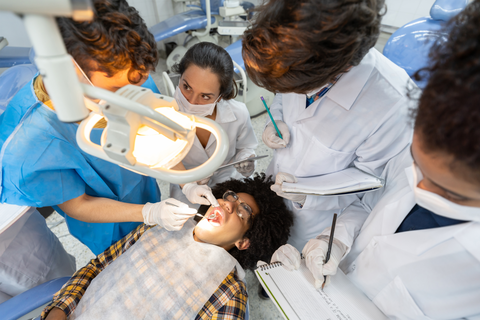
Dentists are doctors who specialize in oral health. They oversee a clinical team and diagnose disease, promote oral health, perform surgical procedures and manage oral emergencies. Dentists may continue their education after dental school to become orthodontists, endodontists and many other specialty fields within dentistry.
Pre-Dentistry is not a major, but rather a compilation of courses and experiences to prepare students for next steps. Professional schools evaluate achievement in required prerequisites, regardless of major. We recommend for students to choose a major they enjoy and in which they can excel. Students are encouraged to receive assistance in planning when to take these prerequisite courses by meeting with a Pre-Professional Advisor each semester in order to remain on track to apply to medical school.

Resources for Success
Study + Excel. A competitive GPA is essential when considering a career in the health field. We recommend maintaining at least a 3.0 GPA. Talk with your academic advisor, professors, and the Academic Success Center for help with study skills through various workshops and tutoring.
Resume + Interviews. Create and/or improve your resume at the Office of Career and Professional Development. You can also gain confidence and develop your interview skills with a video-taped mock interview.
Job Shadow. We recommend that you gain experience by shadowing with a general practice dentist and specialists of your choosing. Document your experiences in a physical or digital format, and obtain at least one letter of reference from a dentist you have shadowed.
Volunteer + Lead. We recommend that you participate in volunteer activities that benefit others. Contact the Office of Leadership and Community Engagement for more information about volunteering with local weekly trips, Alternative Break Trips, and more. We also recommend that you participate in leadership seminars, workshops, retreats and LEAD courses. Get involved and join a student club or organization, such as the Pre-Dental Society or Tri-Beta (biological honors society).
Connect + Explore. Get to know your professors and local health care professionals. These individuals are valuable resources for research experience, volunteering, shadowing and letters of recommendation. Consider Study Abroad programs through the Office of International Programs and Services. Attend information sessions, workshops, field trips, and other events for pre-dental students offered by the Office of Medical Professions Advising.
Research. Talk with your professors and peers who are involved with undergraduate research and consider opportunities within the College of Science and Mathematics.
Prepare for the Dental Admission Test (DAT). This test requires substantial amounts of preparation and study time, so it is never too early to begin. Typically, students prepare to take the DAT in the spring of their junior year, so it is important that necessary coursework be completed by this time.
Biology Courses
- BIOL 1107/L: Principles of Biology I/Lab (4)
- BIOL 1108/L: Principles of Biology II/Lab (4)
- BIOL 2260K: Foundations of Microbiology (4) or BIOL 4240: Biology of Microorganisms (4)
Chemistry Courses
- CHEM 1211K: Principles of Chemistry I/Lab (4 credit hours)
- CHEM 1212K: Principles of Chemistry II/Lab (4)
- CHEM 3401: Organic Chemistry I/Lab (4)
- CHEM 3402: Organic Chemistry II/Lab (4)
- BCHM 3200: Principles of Biochemistry (3) or BCHM 5201: Biochemistry I/Lab (4)
Mathematics and Physics Courses
- MATH 1113: Pre-Calculus (if necessary) (3)
- MATH 1401: Elementary Statistics I (3)
- PHYS 1111K or 2211K: Intro to or Principles of Physics I/Lab (4)
- PHYS 1112K or 2212K: Intro to or Principles of Physics II/Lab (4)
Additional courses to consider
- MATH 1501: Calculus I (4)
- BIOL 3134: Cell and Molecular Biology (3)
- BIOL 3131: Principles of Physiology (3)
- PSYC 1101: Intro to General Psychology (3)
DAT – (Dental Admission Test)
The Dental Admission Test (DAT) is a multiple-choice standardized exam taken by potential dental school students in the United States and Canada. All dental schools require applicants to take the DAT as part of the comprehensive admissions process.
Cost: $525.00 for one-time registration
Length of Test: 5 hours, 15 minutes (inclusive of the pre-, post- and mid-break times)
Score Range: 1 to 30
Test/Retest Policy:
- Candidates must wait 60 days between testing attempts on the DAT, with a maximum of four (4) such administrations permitted during any 12-month period,
- Candidates with three (3) or more attempts on the DAT must apply for permission to test again, providing proof of recent application to dental school with each subsequent application to test
- After the candidate’s fifth DAT attempt, the candidate may retest only once per 12-month period.
The DAT is offered year-round.
To register for DAT, start by reading the Official DAT Candidate Guide.
Once you have read the Guide, apply for the exam with your DENTPIN. Your DENTPIN acts as your unique identifier. If you have not previously applied to a dental program, request your DENTPIN. After your application has been processed, you will receive an eligibility letter that permits you to schedule your testing appointment.
Note: Prospective dental students should take the DAT during the second semester of their junior undergraduate year or during the summer between junior and senior years. Make sure you have taken the subjects covered by the test, especially organic chemistry.
Undergraduate research is great, but only if you are passionate about it. While there are many benefits to getting involved in undergraduate research, it is not required for admission into dental school. Working in a lab setting can add an extra layer to your application if it is something that you are committed to and passionate about. However, if you are not interested in research, you would be better served dedicating that time to other activities such as volunteering and shadowing. If you would like to be involved in research, you should consider dedicating at least a year to the specific project.
If I choose to do research, when should I begin?
You should begin looking for research opportunities as soon as possible. Ideally in your freshman or sophomore year. It can be intimidating to reach out to research mentors so early in your academic career, but you will receive training and support when you join a lab.
Due to course scheduling and the lock-step nature of certain majors, it can sometimes be difficult to fit in research prior to junior or senior year. However, you should not put off research until junior or senior year if you can fit it in sooner. Asking early not only means that you are more likely to find opportunities, but it also gives you the chance to remain in the lab for a longer period of time and to get more deeply involved.
If you are interested in pursing an DDS/DMD-PhD program, you will be expected to have significant research experience.
How do I find research opportunities?
Georgia Southern has many opportunities for research. Nearly every faculty member on campus is conducting some type of research. You can get involved in research in a number of ways: as a volunteer, paid lab assistant or for course credit.
If you are looking to simply volunteer in a laboratory or receive course credit for research, the first step is to make a list of faculty members that are currently doing work you may be interested in. Review departmental webpages or visit the Office of Research’s homepage for more information about opportunities and areas of interest for current research.
Once you have found a lab you are interested in, reach out to the faculty member. E-mail is usually the best way to do this. In your email, express your specific reasons for wanting to join the lab (i.e., what about the research interests you) and provide some details about yourself and your future goals.
Finding a lab does require you to be proactive. Lab openings are limited. You should expect to send out a number of e-mails before you find an open lab. Do not get discouraged!
How “much” research should I do?
Our office recommends that you participate in a research lab for at least a year. However, keep in mind that dental schools care more about the “depth” of your research experience rather than the length of time. In other words, it is important that you are able to talk intelligently and in detail about your role in the lab and the goals/results of the project.
Students interested in a pursuing a dual-degree (e.g., DDS/DMD-PhD) must dedicate a significant amount of time towards research and, if possible, develop their own project. Competitive applicants will have presented their research at conferences or symposiums and some will have written and submitted manuscripts.
Shadowing
As a prospective dental student, you are expected to spend time shadowing a general dentist. Before seeking a shadowing position, please consider HIPAA/patient confidentiality issues. Specifically, this means hands-off observation only. It is important that you do not engage in any activity that could be construed as the practice of dentistry. Even if you plan to specialize, you need to have a bulk of your shadowing hours with a general dentist. The idea behind shadowing is to learn the nuances of patient care. Outside of interacting with and treating patients, dentists have many responsibilities that may include running a business, teaching, or doing research.
Some dental schools require a specific number of shadowing or observation hours. You will want to check the individual websites of the schools to which you plan to apply for these numbers. However, a good benchmark would be around 170-200 hours. Students should also aim for getting a variety of shadowing experiences with at least 2-3 general dentists. (Please note: the Dental College of Georgia prefers student to have around 300 hours of shadowing with 2-3 general dentists). Ideally, you should build a good relationship with at least one DMD or DDS, as it will be important to request a letter of recommendation once you begin the application process. It is good practice to keep an Excel spreadsheet of your hours and journal as you observe patient interaction and procedures. This will be beneficial when you fill out the “experiences” section on your ADEA AADSAS application.
Shadowing Abroad
You may opt to acquire some of your experience in a dental mission abroad. Please note that if you participate in an abroad program, you must never administer care to a patient. You must keep in mind that you should never allow yourself to be put into a position where your actions could be deemed unethical or irresponsible. These actions could ruin your chances for dental school admission.
Volunteering
Volunteering is a large portion of the dental school application which should not be neglected. Dental schools are looking for students who not only demonstrate that they can manage rigorous courses while staying busy, but also those who are compassionate, enjoy working with people and show direct evidence of their dedication to serving their community. Volunteering can be done in a clinical setting such as a hospital or hospice, but it can also be done with organizations such as Habitat for Humanity, the Humane Society, or any other organization (on-campus or off-campus) that you are passionate about. Dental schools are looking for students that show depth of commitment and substantial involvement and leadership in the community.
If attempting to volunteer at a local hospital or clinic (e.g., East Georgia Regional Medical Center or St. Joseph’s/Candler), it is important to be mindful of deadlines and requirements. Most hospitals and clinics have a specific time-window each year that they accept and train potential volunteers. Further, most require volunteers to pass background checks and have up-to-date immunizations and tuberculosis testing. It is your responsibility to research deadlines and requirements when seeking out volunteer opportunities.
Dental Volunteer Opportunities
Dental specific volunteer opportunities in Georgia:
Timeline to Apply: Freshman through Senior Year
Dental Programs in US: American Student Dental Association (ASDA) and ADEA Official Guide to Dental Schools
There is one dental school in Georgia. Specific admissions requirements are available on the school’s website: